

The "I will make you love me" approach to writing rejections.
How to keep going when you shout into the void and void responds, "Thanks for entrusting me with your work, but you're not the right fit."

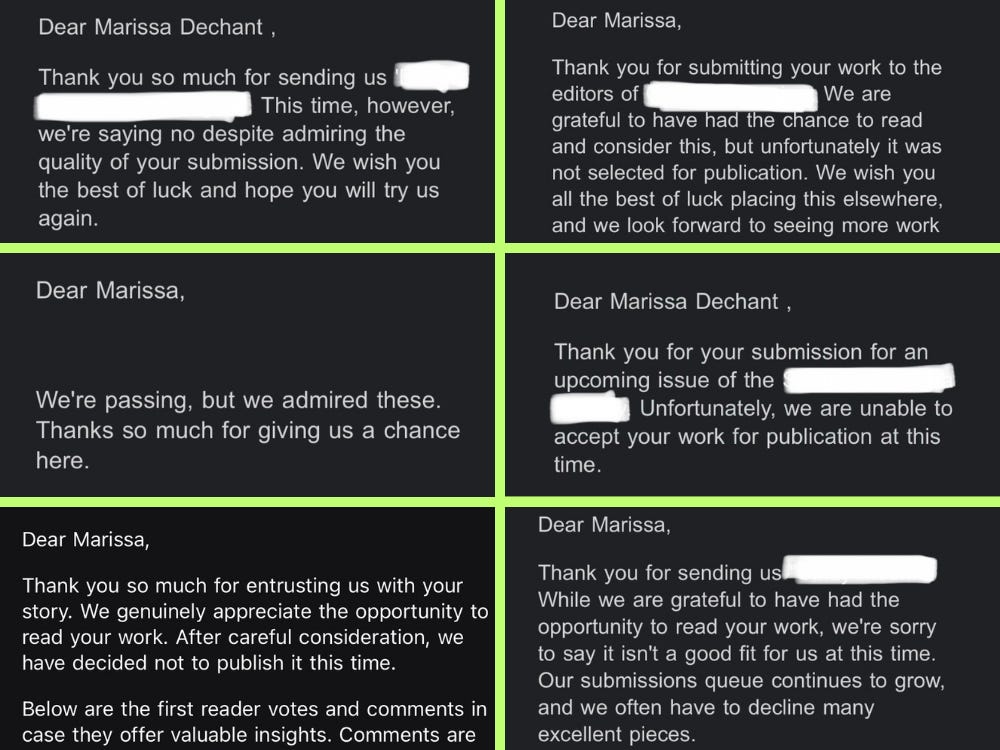
I am on my longest writing rejection streak. Since last summer, a string of nos have found their way into my inbox at all times of day and night, right before Christmas, and even on my birthday, working in tandem to tear me down for ten minutes or totally upset my day. Fellow writers, I know it’s not supposed to get to me—it’s not personal, just keep submitting, something will eventually work out—but it’s getting to me!
Last week, I received three rejections on my short fiction from literary magazines. Two were small heartbreaks, but not surprising due to the competitiveness of the magazines. The third, though, kinda ruined my entire evening. I’ve submitted to the magazine three times. I’ve read a number of stories on the site and think my work is good enough for acceptance. The first two rejections bothered me, but made sense once I calmed down. The stories were a bit lacking, and I’m working especially hard this year to improve my craft. The third rejection, however, made no sense to me. The feedback included in the email was all positive, so I was left scratching my head and feeling very self-righteous and entitled. (This is me saying the ugly, quiet part out loud, and sometimes we have to in order to return to the solitary work of writing and submitting, while recognizing that much goes into rejections that is unknowable and not personal.)
During moments like these, I often feel like giving up. I’m not getting paid, and no one truly cares if my work gets accepted besides me. What’s the point?
The point is that I’m a writer, and most writers, to some extent, want to be seen. The point is that writing makes me feel alive, and I know if I keep going, something will eventually work out. It’s moments like these that make or break you creatively.
I’ve adopted a specific method to receiving rejections that keeps me trekking along. I call it the “I will make you love me” approach wherein after receiving a rejection, I submit to several more magazines the same day to keep stirring my witchy writing brew. It’s really the only productive measure to take in the face of rejection. Some editor at some magazine will eventually love my work, and it’s up to me to make it happen.
But “I will make you love me” is not just a method. It’s a lifestyle (for writing only, please don’t apply this to your love life). Here’s how I maintain an “I will make you love me” attitude because otherwise, I’ll be scream-crying into a pillow while my husband watches from the corner.
Be mad.
Don’t spend too much time on this one. Five minutes tops; if it’s truly bothersome, take the day, but let it wash away in your sleep.
Find lit magazines that excite you.
Use a site like Chill Subs or Duotrope and peruse their databases for magazines that 1. align with your work and 2. publish stories that excite you, punch you in the gut, and/or make you wish you’d written them yourself. This will help you find magazines to which to submit, and reading others’ work is one of the main ways we become better writers ourselves.
I also find it motivating to search for magazines with open submission calls so I can continue actively submitting my work and keep upcoming submission deadlines in mind.
For me, maintaining a list of magazines I admire pushes me to write work (hopefully) worth being published in those mags and also keeps me returning to read their issues for inspiration and a taste of what’s current.
Seek feedback from trusted sources and use it.
Writers are nothing without feedback. We need other eyes on our work to know what lands, what doesn’t, and to receive encouragement from fellow creatives. Revision is part of the process.
So find a trusted friend, family member, or writing group, and let them read your work. You don’t always have to incorporate the feedback into your next draft, but feedback is useful whether or not you act on it.
Good feedback should motivate you and allow you to see your work from a different perspective. Receiving critique is a great practice for putting distance between yourself and your work, so that when it comes to submitting and receiving rejections, you have a level of comfort in allowing your work to stand for itself.
Write with your heart.
If you don’t believe in your work, you will not continue to boldly face rejection. Part of my months-long rejection streak is that I spent much of last year writing stories void of heart, and after so many rejections, I quickly slid the stories into the archives. I didn’t care to rehab such lifeless material, at least for now.
If you do not write with your heart—with vulnerability—if you do not leave a little piece of you in each story you create, you will not face up to the rejection process. If there is not something at stake for you, if you don’t feel like that little piece of you will die if it doesn’t get shown to the world, it will be difficult to keep pushing forward. The rejections that come might initially feel more painful, as if that little piece of you is being rejected, but overall, you will be able to stand by your work and keep submitting because you believe in its worth.
Lock into your practice.
Maintaining a consistent writing routine will keep you focused, motivated, and on a path of improvement. Like most things, the only way to get better at writing is to write. A lot. You will write stories that never see the light of day, that you draft five times and leave to ferment in a folder. These are not failures, they are practice rounds, and who knows? You might return to them months or years down the line and find something shining at you in the dark—a gem of an idea that your past self thankfully left intact.
Keeping this forward momentum will put rejection into perspective: Yes, it’s one piece of the writing process, but it does not define you and will not stop you from getting that well-awaited acceptance someday.
But remember to be human.
We are writers, but that’s not all we are. We may primarily define ourselves by our craft, but our family and friends do not see us that way. We are sarcastic sisters, goofy brothers, compassionate mothers, and good-humored fathers. This is a great reminder when you’re stuck in the muck of rejection. You can and should take a break to avoid burnout and negative self-talk.
It’s normal, good for us, even, to step back, relax, and renew our perspective. We are just tiny ants on a rock floating in space! So what if some person with a made-up degree and credentials doesn’t like your brain ponderings made visible on tree pulp? To be alive and having brain ponderings in the first place is a beautiful wonder!
Seriously, though, breaks are important. They allow us to reflect, self-regulate, and be open to new ideas.
So acknowledge rejection when it happens, take breaks as needed, and maintain the mindset: Someone out there will love your work, and it will be because you made them, through your own determination, skill, and delusions of grandeur.
What I’m Reading
Emma by Jane Austen
I love delving into a classic and am reading along with my sister, a longtime Austen fan. So far it’s charming, and I badly want Emma to be taken down a peg (but love you, girl).
Good reminders! I've had many a long rejection streak. Another writer reminded me that sometimes a rejection is because the piece didn't fit the collection of other accepted pieces for the issue at hand. There are many reasons! Shaking it off and continuing the game is the only way to go. And you'll get a yes before long.